
Our Services
Incorporation Services
We provide comprehensive company incorporation services in India.In India, various types of business entities can be incorporated depending on your business needs, ownership structure, and compliance requirements:
Private Limited
Our team assists with getting your Private Limited company registered with fast track mode and hassle free.
LLP Incorporation
Our team assists with getting your LLP Incorporation registered with fast track mode and hassle free with ease.
Section 8 NGO
Our team assists with getting your NGO company registered under section 8 with fast track mode and hassle free.
OPC Incorporation
Our team assists with getting your OPC company registered under MCA with fast track mode and hassle free.
Taxation Services
Income Tax Notices & Appeals.
Reply and representation for Income Tax Notices issued under various sections of the Income Tax Act.
Preparation and filing of Income Tax Appeals before CIT(A), ITAT and other authorities.
Drafting of submissions, rectification applications and legal replies to tax department.
Assistance during scrutiny assessment, reassessment and faceless proceedings.
Tax litigation advisory and representation for penalty, demand and refund matters.

Transfer Pricing (TP) compliances
- Transfer Pricing Applicability Check
- Benchmarking Study / Arm’s Length Price (ALP) Analysis
- Preparation of Transfer Pricing Documentation (Local File)
- Master File Compliance
- Country-by-Country Reporting (CbCR)
- Transfer Pricing Audit Support
- APA (Advance Pricing Agreement) Services
- Safe Harbour Compliance
- Specified Domestic Transaction (SDT) Compliance
- Cross-Border Tax Advisory
- Transfer Pricing Health Check / Risk Review
- Year-End TP Adjustment Advisory
NRI Taxation
Our NRI Taxation Services Include:
 Income Tax Return (ITR) Filing for NRIs
- Capital Gains Tax on Property Sale
- TDS Advisory & Lower TDS Certificate
- DTAA (Double Taxation Avoidance Agreement)
- Rental Income Taxation & Compliances
- Repatriation of Funds Advisory
- NRO/NRE Account Tax Guidance
- Tax Planning & Refund Assistance

Capital Gain on Sale of property
1️⃣ Types of Capital Gains
✅ Short-Term Capital Gain (STCG)
If property is sold within 24 months of purchase.
Taxed at normal income tax slab rates.
✅ Long-Term Capital Gain (LTCG)
If property is sold after 24 months.
Taxed at 20% with indexation benefit
- Taxed at 12.5% without indexation benefit

Tax on Purchase of Property
🔹 1️⃣ Applicable to Buyer
Applies to the buyer of immovable property.
If Sale Consideration < Stamp Duty Value, then Stamp Duty Value is deemed as sale consideration for capital gain calculation.
This increases the buyer’s tax liabilities.
✅ Safe Harbour Rule
If the difference between actual consideration and stamp duty value does not exceed 10%, actual sale price can be accepted.
✅ TDS Deduction
TDS is 1% for Resident and Special rate for NRI.

Taxation Law for Transferring Money Outside India
🔹 1️⃣ Governing Law – FEMA
Foreign remittances are regulated under:
Foreign Exchange Management Act (FEMA), 1999
All outward remittances must comply with FEMA rules and RBI guidelines.
🔹 2️⃣ Liberalised Remittance Scheme (LRS)
Under RBI’s LRS:
Resident individuals can remit up to USD 250,000 per financial year.
Permitted for:
Investment in foreign companies
Setting up wholly owned subsidiary
Acquisition of shares abroad
Business investment
Remittance must be made through authorized banks.

Tax on Higher Salary Individual
✅ 1. Income Tax Compliances (Salary > ₹1 Cr)
✅ 2. TDS Compliance on Rent (VERY CRITICAL)
✅ 3. Stock Market Investment Compliance
📌 A. Form 26AS Reconciliation
📌 B. Foreign Assets (if any)
📌 C. High-Value Transactions
📌 D. HRA Claim (if applicable)
✅ 5. Strategic CA Advisory (Important for You)
⚠️ Common Notices Risk Areas
- Non-deduction of TDS on rent
- Mismatch in AIS vs ITR
- Incorrect capital gains reporting
- Claiming HRA without TDS compliance
✅ Quick Summary
✔ ITR-2 filing mandatory
✔ Advance tax critical
✔ TDS on rent (2%)
✔ Capital gains proper reporting
✔ AIS reconciliation
✔ Surcharge applicability
Income Tax Return Filling in India
- ITR-1 Individual
- ITR-2 Individual
- ITR-3 Business
- ITR-4 Business
- ITR-5 Partnership Firm
- ITR-6 Private Limited Company
- ITR-7 Trust NGO Society
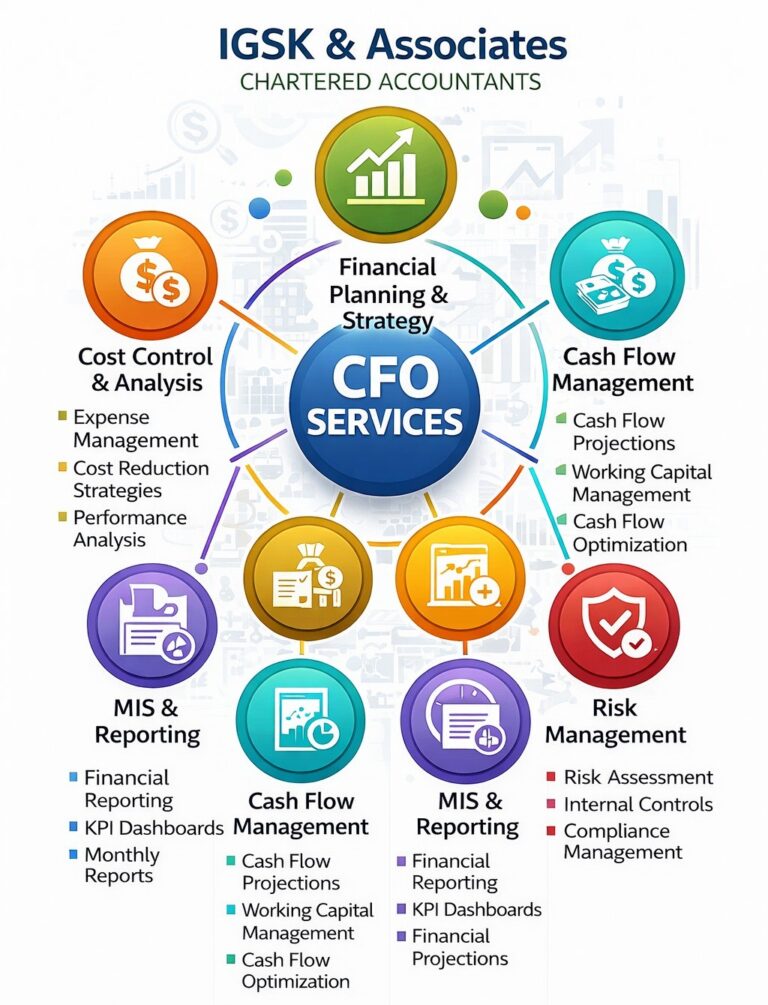
Virtual CFO Services
Why Virtual CFO Services Are Important for MSMEs
Micro, Small and Medium Enterprises (MSMEs) are the backbone of the Indian economy. However, most MSMEs cannot afford a full-time Chief Financial Officer (CFO). That’s where Virtual CFO (vCFO) services become highly valuable.
Registered MSMEs under the Ministry of Micro, Small and Medium Enterprises benefit significantly from professional financial management without bearing the high cost of a full-time CFO.
ROC Services
 Private Limited Company
Filing of Annual Return in Form MGT-7.
Filing of Financial Statements in Form AOC-4.
Conducting Annual General Meeting (AGM).
Maintenance of proper Books of Accounts, statutory registers.
Appointment or re-appointment of Statutory Auditor.
Filing of Director KYC in DIR-3 KYC.
Filing of MSME, if applicable.
Filing of DPT-3 Return for reporting outstanding loans.
Reporting of changes in directors, registered office.
Compliance with board meetings, maintenance of resolutions.
 Limited Liability Partnership
Filing of Annual Return in Form 11 .
Filing of Statement of Account and Solvency in Form 8 .
Maintaining proper books of accounts .
Preparation and filing of Income Tax Return.
Filing of GST Returns regularly.
Renewing Digital Signature Certificate (DSC) .
Completion of Director KYC compliance .
Filing of LLP Agreement.
Reporting any change in partners, registered office address.
Conducting audit of accounts.
3️⃣ Section 8 Company
Filing of Annual Return in Form MGT-7.
Filing of Financial Statements in Form AOC-4.
Conducting minimum Board Meetings.
Preparation and maintenance of statutory registers.
Filing of Director KYC in Form DIR-3.
Appointment of Auditor and filing of Form ADT-1.
Holding Annual General Meeting (AGM) .
Filing of Form INC-12, INC-13, or other ROC forms .
Compliance with Head Office Address changes.
Filing of event-based ROC forms for changes in directors.
4️⃣ One Person Company (OPC)
Every One Person Company (OPC) is required to maintain proper books of accounts.
OPC must file Annual Financial Statements in Form AOC-4 .
OPC is required to file Annual Return in Form MGT-7A .
The Director of OPC must complete Director KYC.
OPC is required to prepare and maintain statutory registers.
The company must conduct at least one Board Meeting .
OPC should file Form ADT-1 for appointment of Auditor.
In case of any change in registered office, directors, or share capital.
OPC must file regulations regularly.
OPC is required to comply with event-based ROC filings.
GST Services
1️⃣ GST Registration Services
New GST Registration
Amendment in Registration
Cancellation / Revocation
LUT Filing (Export without payment of tax)
Aadhaar Authentication
GST Migration cases
2️⃣ Monthly / Quarterly GST Returns
🔹 Regular Taxpayer
GSTR-1 – Outward Supply Return
GSTR-3B – Summary Return & Tax Payment
GSTR-9 – Annual Return
GSTR-9C – Reconciliation Statement (if applicable)
3️⃣ Department Notices Handling
Show Cause Notice (SCN) reply
ASMT-10 (Mismatch notice)
DRC-01 / DRC-07 proceedings
DRC-01A (Pre-consultation notice)
GST Registration cancellation notice
4️⃣ Appeals & Representation
Appeal before Appellate Authority (GST APL-01)
Representation before GST Officer
Rectification applications
Pre-deposit calculations
Audit Services
1️⃣ Tax Audit
📘 Meaning:Tax Audit is conducted under Section 44AB of the Income Tax Act, 1961.It is mandatory when turnover exceeds prescribed limits.
📌 Applicability (General Limits)
Business turnover above ₹1 crore
(₹10 crore if cash transactions ≤5%)Profession receipts above ₹50 lakh
📌 Objective:
Ensure proper maintenance of books
Verify compliance with income tax provisions
Report disallowances & tax adjustments
📌 Forms:
Form 3CA / 3CB
Form 3CD (Audit Report)
📌 Filed With:
Income Tax Department
2️⃣ Statutory Audit
📘 Meaning:Statutory Audit is compulsory under the Companies Act, 2013.Every company (Private Ltd, OPC, Section 8, Public Ltd) must get accounts audited annually — irrespective of turnover.
📌 Objective:
Verify true & fair view of financial statements
Ensure compliance with Companies Act
Protect shareholders’ interest
📌 Auditor Appointment:
Filed in ADT-1 with Ministry of Corporate Affairs
📌 Applicable To:
Private Limited Company
Public Company
OPC
Section 8 Company
(Not mandatory for LLP unless turnover exceeds limits)
3️⃣ Internal Audit
📘 Meaning:Internal Audit is an independent evaluation of internal controls, risk management & operational efficiency.
📌 Mandatory For (Companies Act Criteria):
As per Section 138 of Companies Act, 2013, applicable to:
Listed companies
Certain unlisted companies based on turnover, loan, or paid-up capital limits
📌 Objective:
Improve internal control system
Prevent fraud & errors
Risk management
Process improvement
📌 Nature:
✔ Continuous process
✔ Conducted quarterly/periodically
✔ Report submitted to management
4️⃣ Audit Liaisoning Office
📘 Meaning:Audit Liaisoning means representing client before tax or government authorities during audit or assessment. It is not a type of audit, but a professional representation service.
📌 Covers:
Income Tax scrutiny cases
GST audit & departmental audit
Notice handling
Document submission
Reply drafting
Personal hearing representation
📌 Authorities Involved:
Income Tax Department
Central Board of Indirect Taxes and Customs
Ministry of Corporate Affairs
📌 Objective:
Ensure smooth compliance
Reduce penalties
Proper documentation & legal defence
Company Set-up in UAE
UAE Company Incorporation
1️⃣ Mainland Company
📘 Registered With:Department of Economic Development (DED) of respective Emirate
(Example: Dubai Department of Economy and Tourism)
📌 Main Features:
Can do business anywhere in UAE
Can trade directly in UAE local market
Eligible for government contracts
100% foreign ownership allowed in most activities
📌 Common Types:
Limited Liability Company (LLC)
Sole Establishment
Civil Company
Branch of Foreign Company
2️⃣ Free Zone Company
📘 Registered With:Specific Free Zone Authority
📌 Popular Free Zones:
Dubai Multi Commodities Centre
Jebel Ali Free Zone
Sharjah Media City
RAK International Corporate Centre
📌 Features:
100% foreign ownership
0% corporate tax (subject to conditions)
Customs benefits
Easy setup process
Cannot trade directly in mainland without local distributor
3️⃣ Offshore Company
📘 Purpose:
International business
Asset holding
Tax planning
No physical office requirement
📌 Popular Offshore Jurisdictions:
JAFZA Offshore
RAK International Corporate Centre
📌 Features:
No business inside UAE
No visa eligibility
No physical office required
100% foreign ownership
4️⃣ Limited Liability Company (LLC)
Most common structure in UAE.
📌 Key Points:
1 to 50 shareholders
Liability limited to share capital
Suitable for trading & services
Can be mainland or free zone
5️⃣ Branch Office
📌 Types:
Branch of Foreign Company
Branch of UAE Company
📌 Features:
100% owned by parent company
Cannot conduct activities outside parent scope
6️⃣ Professional License Company
For consultancy, CA, doctors, engineers
Can be 100% foreign owned
Local Service Agent may be required
📌 Features:
100% owned by parent company
Cannot conduct activities outside parent scope
UAE Corporate Tax
Corporate Tax in UAE is governed by:
👉 Federal Decree-Law No. 47 of 2022 on the Taxation of Corporations and Businesses
👉 Issued and administered by the Federal Tax Authority
1️⃣Introduction
UAE introduced Corporate Tax (CT) effective from:
📅 1 June 2023 onwards
(Applicable from first financial year starting on or after 1 June 2023)
Example:
If FY = 1 Jan 2024 – 31 Dec 2024 → CT applicable for 2024.
2️⃣ Corporate Tax Rate
| Taxable Income | Tax Rate |
|---|---|
| Up to AED 375,000 | 0% |
| Above AED 375,000 | 9% |
| Large MNCs (Global revenue > €750M) | 15% (Pillar 2 rules) |
3️⃣ Who is Subject to Corporate Tax?
📌 Taxable Persons
✔ Mainland Companies (LLC, PJSC, etc.)
✔ Free Zone Companies
✔ Foreign Companies with UAE Permanent Establishment
✔ Natural persons (if business income > AED 1 million annually)
📌 Exempt Persons
Government entities
Certain public benefit entities
Investment funds (conditions apply)
4️⃣ Free Zone Corporate Tax Treatment
Free Zone Companies can qualify as:
⭐ Qualifying Free Zone Person (QFZP)
0% tax on qualifying income
9% on non-qualifying income
Conditions:
Maintain adequate substance
Comply with transfer pricing
File CT return
Meet qualifying income criteria
If conditions not satisfied → 9% on total income.
5️⃣ Corporate Tax Registration
📌 Mandatory Registration:
All taxable persons must register with:
👉 Federal Tax Authority
Even if:
Income is below AED 375,000
Loss making company
Free zone entity
📌 Registration Process:
Create account on EmaraTax portal
Submit trade license
Provide MOA, shareholder details
Emirates ID & passport copies
Financial year details
Obtain Corporate Tax Registration Number (TRN)
6️⃣ Corporate Tax Compliances
📌 1️⃣ Annual Corporate Tax Return
Filed within 9 months from end of financial year
Example:
FY ending 31 Dec 2024 → Return due by 30 Sept 2025
📌 2️⃣ Tax Payment
Pay within 9 months from year end
📌 3️⃣ Maintain Books of Accounts
As per accounting standards
Retain records for 7 years
📌 4️⃣ Transfer Pricing Compliance
Maintain TP documentation
Related party disclosure
Arm’s length pricing
📌 5️⃣ Small Business Relief (Optional)
If turnover ≤ AED 3 million → can opt for relief (subject to conditions).
7️⃣ Allowable & Non-Allowable Expenses
✔ Allowable:
Business expenses
Salaries
Rent
Depreciation
Interest (subject to limit)
❌ Not Allowable:
Fines & penalties
Personal expenses
Certain related party excess payments
8️⃣ Losses Under Corporate Tax
✔ Loss can be carried forward (up to 75% of taxable income)
✔ Group relief available
✔ Business restructuring relief available
VAT LAW IN UAE
VAT in UAE is governed by:
👉 Federal Decree-Law No. 8 of 2017 on Value Added Tax
👉 Executive Regulations issued under Cabinet Decision No. 52 of 2017
👉 Administered by the Federal Tax Authority
📅 VAT implemented from 1 January 2018.
1️⃣ What is VAT?
VAT (Value Added Tax) is an indirect tax charged on supply of goods and services at each stage of value addition.
📌 Standard VAT Rate: 5%
2️⃣ VAT Registration in UAE
🔹 A) Mandatory Registration
A business must register for VAT if:
Taxable supplies exceed AED 375,000 in last 12 months
ORExpected to exceed AED 375,000 in next 30 days
🔹 B) Voluntary Registration
If turnover exceeds AED 187,500, business may register voluntarily.
🔹 C) Who Must Register?
✔ Mainland Companies
✔ Free Zone Companies (most free zones treated as mainland for VAT)
✔ Sole establishments
✔ Branches
✔ Importers
(Note: Designated Zones have special treatment)
📌 VAT Registration Process
Create account on FTA portal
Submit:
Trade License
MOA
Emirates ID & passport
Bank details
Turnover proof (invoices / contracts)
Receive VAT TRN (Tax Registration Number)
3️⃣ VAT Categories of Supply
| Type of Supply | VAT Rate |
|---|---|
| Standard Rated | 5% |
| Zero Rated | 0% |
| Exempt | No VAT |
| Out of Scope | No VAT |
🔹 Zero Rated Supplies (0%)
Export of goods/services
International transportation
Certain healthcare & education
First supply of residential property
🔹 Exempt Supplies
Financial services
Residential rent
Bare land
Local passenger transport
4️⃣ VAT Compliance Requirements
📌 1️⃣ VAT Return Filing
Monthly or Quarterly (as assigned by FTA)
Due within 28 days after tax period end
Example:
Quarter ending 31 March → Return due 28 April
📌 2️⃣ VAT Payment
Pay VAT liability before due date
📌 3️⃣ VAT Records Maintenance
Maintain records for 5 years
Tax invoices
Credit notes
Import/export documents
Accounting records
📌 4️⃣ Tax Invoice Requirements
Must include:
Supplier TRN
Invoice number
Date
Description
VAT amount
5️⃣ Input Tax Credit (ITC)
Business can claim input VAT if:
✔ Expense is business related
✔ Valid tax invoice available
✔ VAT paid to supplier
❌ Blocked Input VAT:
Entertainment expenses
Personal expenses
Motor vehicles (certain cases)
6️⃣ Special VAT Areas
🔹 Reverse Charge Mechanism (RCM)
Applicable on:
Import of goods
Certain foreign services
🔹 Designated Zones
Certain free zones treated as outside UAE for VAT on goods (conditions apply).
🔹 VAT Group Registration
Companies under common control may apply for VAT Group.
7️⃣ VAT Penalties (General Overview)
As per FTA administrative penalty decisions:
Late registration penalty
Late return filing penalty
Late payment penalty
Incorrect filing penalty
Failure to issue tax invoice penalty
8️⃣ VAT Deregistration
Mandatory if:
Turnover falls below AED 187,500
Business ceases
Must apply within 20 business days.
Maintain Books in UAE
Maintenance of books of accounts in UAE is mandatory under:
👉 Federal Decree-Law No. 32 of 2021 on Commercial Companies
👉 Federal Decree-Law No. 47 of 2022 on the Taxation of Corporations and Businesses
👉 Federal Decree-Law No. 8 of 2017 on Value Added Tax
Companies must maintain proper accounting records to reflect a true and fair view of financial position.
✅ 1️⃣ Statutory Requirement under UAE Commercial Companies Law
As per the Commercial Companies Law:
Every company must maintain proper accounting books
Books must reflect financial position accurately
Records must be kept at registered office
Must be retained for minimum 5 years
Failure may result in penalties and legal action against directors.
✅ 2️⃣ Requirement under UAE Corporate Tax Law
Under Corporate Tax Law:
Taxable persons must maintain records to determine taxable income
Records must support:
Revenue
Expenses
Related party transactions
Transfer pricing
Tax adjustments
Books must be retained for 7 years
Administered by:
👉 Federal Tax Authority
Without proper books:
❌ Tax return cannot be filed accurately
❌ Small Business Relief may be denied
❌ Free Zone 0% benefit may be rejected
❌ Heavy penalties may apply
3️⃣ Requirement under UAE VAT Law
Under VAT Law:
Maintain tax invoices
VAT returns
Import/export documents
Debit/Credit notes
Records for 5 years (15 years for real estate)
If records are not maintained:
Input VAT credit may be disallowed
Administrative penalties may apply
VAT refund claims may be rejected
4️⃣ Importance from Practical Business Perspective
📌 1️⃣ Corporate Tax Compliance
Accurate books help:
Calculate taxable profit
Identify allowable expenses
Track tax losses
Avoid penalties
📌 2️⃣ VAT Compliance
Correct VAT calculation
Proper ITC claim
Avoid mismatch notices
📌 3️⃣ Bank & Loan Approval
Banks require:
Audited financial statements
Profit & loss statement
Cash flow statement
📌 4️⃣ Investor & Shareholder Confidence
Investors evaluate:
Profitability
Debt position
Business growth
📌 5️⃣ Business Decision Making
Helps management:
Control expenses
Improve cash flow
Plan expansion
5️⃣ Minimum Books & Records to Maintain
✔ General Ledger
✔ Sales Register
✔ Purchase Register
✔ Bank Book
✔ Fixed Asset Register
✔ Payroll records
✔ VAT records
✔ Related party documentation
⚠️ Consequences of Not Maintaining Proper Books
FTA audit risk
Corporate Tax penalties
VAT penalties
Director liability
Company strike-off risk
Difficulty in visa renewal or bank compliance